September 16th, 2026
Beyond Engineering: The KGPians Who Found Their Voice in Books
IITKGP Foundation
IIT Kharagpur has long been associated with engineering, science, technology and entrepreneurship. But the KGP story is also a literary one. Across generations, alumni have become journalists, novelists, historians, biographers, management thinkers and public intellectuals—taking the analytical discipline of KGP into the very different worlds of books and ideas.
From the newsroom to the novel
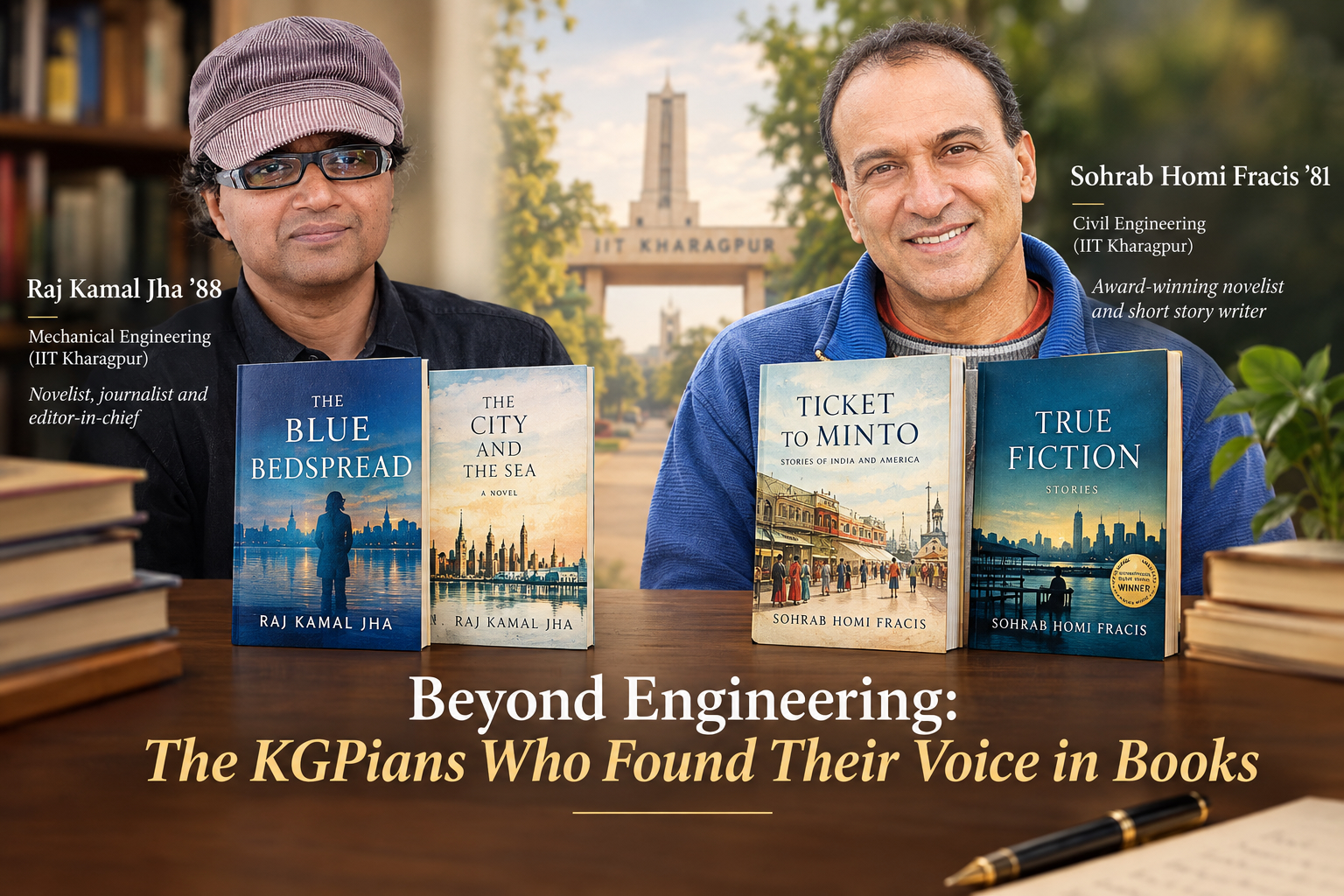
Some KGPians have combined journalism with distinguished literary careers. Raj Kamal Jha ’88 (Mechanical Engineering) began writing at KGP as editor of Alankar, the campus magazine, before becoming Editor-in-Chief of The Indian Express and an acclaimed novelist whose works include The Blue Bedspread, Fireproof and The City and the Sea. Sandipan Deb ’86 (Electronics & Electrical Communication Engineering) went on to senior editorial positions at Outlook and The Financial Express and founded several publications, including Outlook Money, Open and Swarajya, while also writing books and fiction. Their journeys show how a KGP education can lead not only to building things, but to questioning institutions and shaping public conversation.
Engineers who became storytellers
Other alumni followed an even more unexpected path into fiction. Sohrab Homi Fracis ’81 (Civil Engineering) became an award-winning American fiction writer, winning the Iowa Short Fiction Award for Ticket to Minto: Stories of India and America and later the International Book Award for Short Fiction for True Fiction. His work explores migration, identity and the experience of living between India and America. Sudipto Das '95, meanwhile, has blended technology, history and mystery in novels including The Ekkos Clan, The Aryabhata Clan and The Broken Amoretti, as well as in his biography Jagadish Chandra Bose: The Reluctant Physicist. For KGP readers, there is a delightful connection: The Broken Amorettiis set partly against the backdrop of IIT Kharagpur. Aakash Neeraj Mittal (2016), another KGP alumnus, has also turned to fiction, writing It Wasn't Her Fault, a novel engaging with contemporary issues of crime and women's safety.
Chronicling India—its people, culture and ideas
A number of KGPians have used nonfiction to explore India's history and cultural heritage. Namit Arora '89, a KGP alumnus who spent years in technology before becoming a full-time writer, is the author of Indians: A Brief History of a Civilization, an expansive account of Indian civilization spanning 5,000 years. Anirudha Bhattacharjee '86, a Distinguished Alumnus, has become a chronicler of India's popular culture, writing acclaimed biographies and histories of figures including R.D. Burman, S.D. Burman, Kishore Kumar and filmmaker Basu Chatterji; his first book won the National Award for Best Book on Cinema. J. Sai Deepak ’09 (Law) has brought his legal and historical scholarship to a wider audience through India, That Is Bharat: Coloniality, Civilisation, Constitution, while Subir Chowdhury has authored some 15 books on quality, leadership and management. Rajeev Agarwal, a KGP engineering graduate, turned the lessons of his career in technology, business and entrepreneurship into the popular What I Did Not Learn at IIT series.
A literary legacy hiding in plain sight
What connects these alumni is not a particular genre or profession, but a willingness to look beyond the obvious. Yet their journeys share something distinctly KGP: curiosity, analytical thinking and the confidence to tackle difficult questions—even when those questions have little to do with engineering. From Alankar to The Indian Express, from Civil Engineering to the Iowa Short Fiction Award, and from KGP's classrooms to bookshelves around the world, these alumni remind us that the KGP imagination extends far beyond engineering.
Two New Books, Two Distinct KGP Perspectives
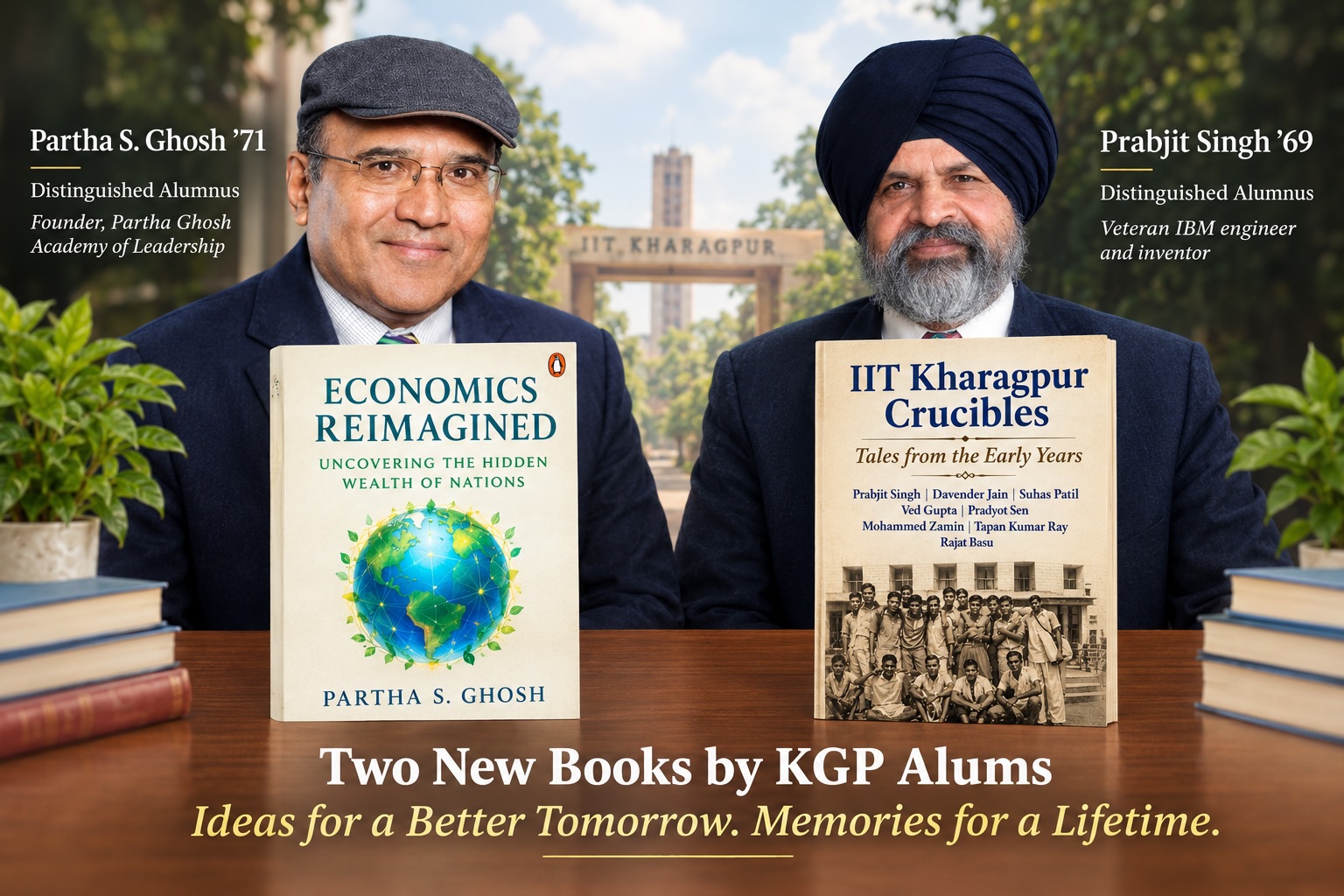
The intellectual range of KGPians continues to find expression in books. Partha S. Ghosh ’71, Distinguished Alumnus and founder of the Partha Ghosh Academy of Leadership, turns his attention to the future of economics in Economics Reimagined: Uncovering the Hidden Wealth of Nations. Challenging conventional economic models, Ghosh proposes “Cellularism,” a human- and nature-centered framework that views economies as living, interconnected and regenerative systems.
A very different kind of history comes alive in IIT Kharagpur Crucibles: Tales from the Early Years, edited by Prabjit Singh ’69 and featuring contributions from IITKGP alumni Davender Jain, Suhas Patil, Ved Gupta, Pradyot Sen, Mohammed Zamin, Tapan Kumar Ray and Rajat Basu. Drawing on the memories of KGP's pioneering generations of the 1950s and 1960s, the book brings together personal stories of campus life, friendships and formative experiences—and follows the contributors as they went on to careers spanning engineering, technology, industry, entrepreneurship, public service, the arts and philanthropy. Singh himself is a Distinguished Alumnus and a veteran IBM engineer and inventor.